
I’ve lost count of the number of students who have messaged me in a panic: “My application was rejected. The portal said my transcript translation wasn’t valid.”
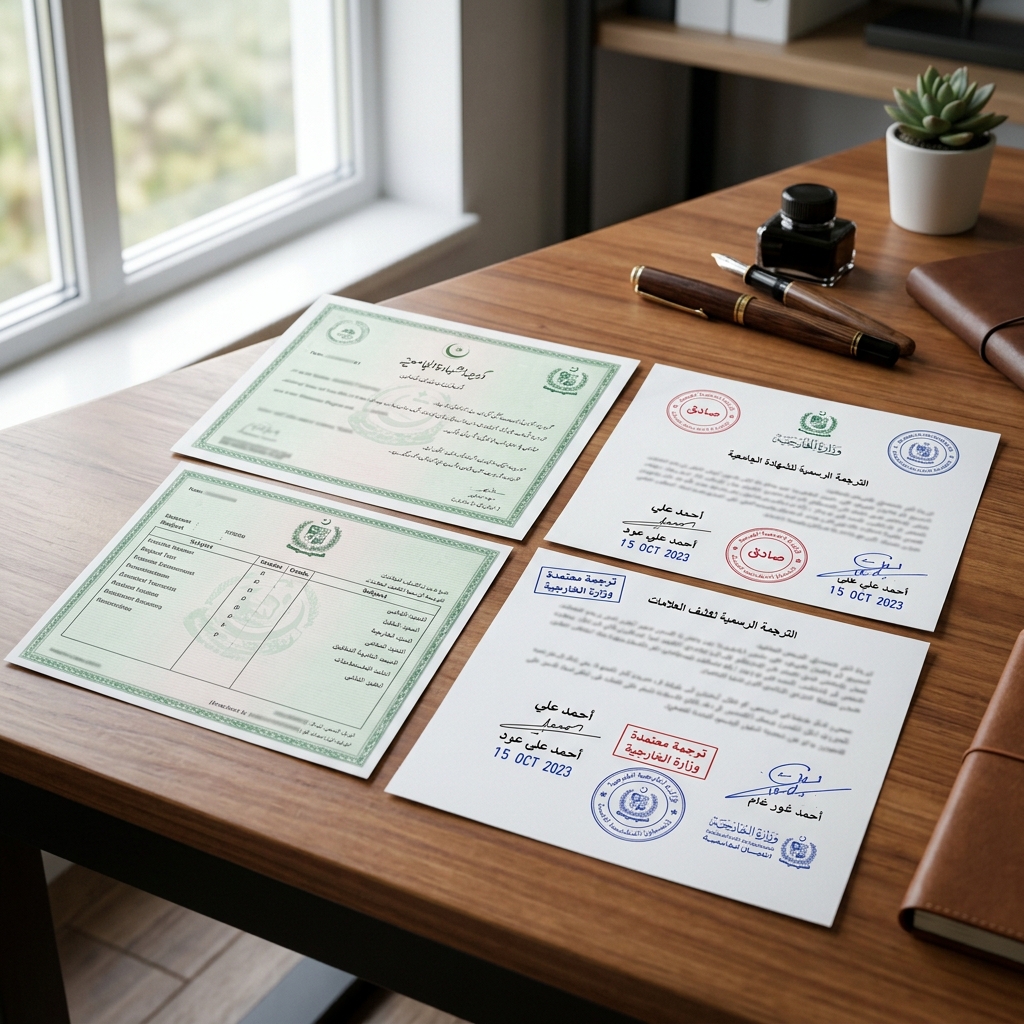
They had a translation. Somebody had converted the words. But the scholarship committee didn’t accept it. Why? Because the transcript they submitted looked nothing like the original. The stamps were missing from the translation. The signature reference was omitted. The table was reformatted into a messy paragraph. The document had been translated — but it hadn’t been certified. And it certainly hadn’t been rebuilt.
Transcript translation for Saudi scholarship applications is not a language task. It’s a forensic document reconstruction exercise. That’s what this article is about. Not generic advice. Just the detailed, unglamorous, absolutely crucial reality of what it takes to translate a Pakistani transcript into an Arabic document that a Saudi university actually accepts.
The Transcript Is Not a Paragraph. It’s a Fingerprint.
A degree certificate usually contains 5 or 6 lines of text. It’s easy. A transcript, however, is dense. It contains:
- A table of 30 to 60 subjects with codes, credit hours, and grades.
- Handwritten marks from older boards.
- The university’s embossed logo and registrar’s signature.
- A grading scale legend in tiny print.
- Possibly two languages mixed — Urdu subject titles alongside English column headers.
If your translator treats this like an ordinary document to be typed up in Word, the Saudi reviewer will open the file and immediately see a mismatch. They won’t read it. They’ll reject it.
[!TIP] What I tell every student: Your transcript translation must look, at a glance, like the Arabic twin of the original. If the layout is different, trust is gone.
Send me a photo of your transcript. I’ll tell you what needs to be done →
What a Saudi Reviewer Actually Does With Your Translated Transcript
The person reviewing your scholarship application may see 200 files a day. They don’t read every word of your transcript translation. They perform three visual checks first:
- Page Count: Does the translated document have the same number of pages as the original? A 6-page transcript cannot become a 3-page translation.
- Stamp Placement: Are the stamps and signatures referenced in the correct positions? They look for bracketed notes like
[Official Stamp of University of the Punjab]at the exact location where the stamp appears on the original. - Structural Integrity: Is the table structure preserved? They scan the columns. If the original has columns for “Course Code,” “Subject,” “Marks Obtained,” the translation must have those same columns in the same order.
Only if these three checks pass do they read the subjects and grades. The document’s visual fidelity is the first gate. Most rejected translations fail before anyone reads a single course title.
The Formatting Rule That 90% of Translators Break
Here’s the rule that separates accepted translations from rejected ones: the translation must mirror the original’s structure cell for cell, line for line.
I’ve seen generic translators do this:
- They take the transcript, copy all the text, and paste it into a continuous Arabic paragraph.
- Or they build a table but reorder the columns to “look neater.”
- Or they summarise: “Semester 1 courses included Mathematics, Physics…” instead of listing every subject.
This is a fast track to rejection. The scholarship portal compares the original scan and the translation side by side. If the structures don’t match, the document is flagged as “unverifiable.”
[!IMPORTANT] Reconstruction over Translation: We reconstruct the transcript in Arabic as a precise table. Every course code, every subject, every credit hour, every grade stays in its original row and column. The layout is not approximated. It is reproduced. This adheres to the strict 2026 Saudi scholarship document rules.
Stamps, Seals, and Signatures — Why the Arabic Version Must Show What It Cannot Copy
You cannot stick an actual stamp on a digital Arabic translation. But you must prove to the Saudi reviewer that you saw the stamp, you know where it is, and your translation is faithful to it.
Here’s what a properly certified transcript translation includes:
- Seal location notes in brackets:
[Round blue stamp: University of Karachi – Examination Branch]placed at the exact position of the original. - Signature notation:
[Signed: Controller of Examinations]on the line where the original signature appears. - Embossed stamp references:
[Embossed dry seal visible on original]with a description. - The translator’s own stamp and signature: This is separate. Our certification stamp goes on the final page, clearly identifying us as the certifying authority for your certified Arabic translation for scholarships.
Real Failures I’ve Seen (And Fixed) at the Last Minute
- The Sideways Stamp: A student submitted a translation where the translator had described a stamp as “illegible.” The university interpreted that as “potentially forged.” We re-translated, zoomed in, identified the stamp’s partial text, and noted it properly. Accepted.
- The Missing Part II Marks: A Lahore Board Intermediate certificate had marks split across two separate sheets. The previous translator translated only Part I. The portal flagged it as incomplete. We translated both parts and the student submitted successfully with 8 hours to spare.
- The Name Reversal: “Ali Ahmed” in the transcript became “Ahmed Ali” in the translation. Saudi authorities matched against the passport and flagged a mismatch. We corrected the order, re-certified, and the application was saved.
Urgency Without Sacrifice — How We Deliver Accurate Transcripts Fast
Speed is necessary. Deadlines are real. But speed cannot come at the cost of accuracy. We handle urgent transcript translations by:
- Parallel Processing: Deploying two translators to work on a large transcript simultaneously with a single formatter ensuring visual consistency.
- Library of Terms: Using a library of pre-verified Saudi university terminology so we don’t waste time researching subject titles.
The result: a 6-page bachelor’s transcript can be delivered in 24 hours. We don’t skip steps. We compress time through process, not shortcuts.
My deadline is extremely close. Can you do it? Let’s talk →
FAQ: Transcript Translation for Saudi Scholarship — The Unspoken Rules
See the sidebar/bottom for our full FAQ schema with deep dives into CGPA legends and handwritten notes.
Your Transcript Is a Legal Document. Let’s Translate It Like One.
You’re asking the Kingdom of Saudi Arabia to fund your education. They will check. They will compare. They will only trust a translation that trembles with precision — down to the placement of a stamp, the rendering of a signature, and the exact layout of a 40-row table.
That’s the kind of transcript translation for Saudi scholarship applications I deliver. Not fast and sloppy. Fast and exact. Certified. Accepted.
Authority Sources & Further Reading:
- Saudi Cultural Mission (SACM): Document Authentication Guidelines
- Qatar Ministry of Education: Transcript Equivalency Requirements
- University of the Punjab: Official Transcript Issuance Format
- Credential Evaluation Expert: How to Identify Genuine Documents
Need a Certified Translation?
To get a quote, you can send your scanned documents to our WhatsApp number: +92-328-8155866.
Need Expert Help with Your Documents?
Our Saudi scholarship consultants are ready to assist you with certified translations and attestation requirements. Get a response in minutes.
Written by Lisan.pk Editorial Team
Expert consultant at Lisan.pk specializing in international document legalization and translation services.
Related Articles
Saudi Arabia Fully Funded Scholarships 2026/27: Bachelor, Master & PhD Programs
Explore Saudi Arabia fully funded scholarship programs 2026/27 for international and Pakistani students, including Bachelor’s, Master’s and PhD options.
Scholarship GuidesSaudi Scholarship Application Assistance Pakistan: Study in Saudi Complete Support 2026
Need Saudi scholarship application assistance in Pakistan? Compare document & translation support with complete Study in Saudi application help, program selection and final review.
Scholarship GuidesSaudi Scholarship Application Cost in Pakistan 2026: Translation, Documents & Full Support
See Saudi scholarship application costs in Pakistan for 2026, including PKR 12,000 Bachelor’s and PKR 15,000 Master’s/PhD document packages, translation rates and application support.